How to Write a Reflection Entry That Goes Beyond a Diary Rant

It's half past eleven. You open your journal because something has been sitting on your chest all day, and forty minutes later you have filled three pages with the same complaint, told six different ways. You close the book. Nothing has changed, except that you are now tired as well as angry.
Venting is not the problem. Getting the pressure out of your head and onto paper is genuinely useful, and pretending to be serene when you are not helps nobody. But a rant only does half the job: it empties the room without opening a window. What follows is a method for adding the second half — calmly, honestly, and without turning your journal into a self-improvement project you quietly abandon by February.
Why a rant runs out of road
Rant entries tend to circle one level: the event and the grievance. She said that, so I felt this, and that is so typical of her. That level is real, but it is also repetitive. Read back a month of entries written there and you will notice the same scene with different names in it.
Reflection is not the opposite of honesty. It is honesty with more of the picture included. You keep the anger on the page — you simply also note what it was protecting, what you wanted, and what you might do next.
Step one: separate what happened from what you decided
Draw a line down the middle of the page, mentally or literally. On the left, write what a camera would have recorded. On the right, write what you concluded about it.
Happened: My sister didn't reply to my message for two days.
Decided: She doesn't care about me. I'm always the one who makes the effort.
One of those is a fact. The other is a story — a reasonable story, perhaps, but a story. Stories are not lies; they are interpretations built quickly from old material. Labelling them as interpretations loosens their grip, because you can then ask a better question: what else could explain the same facts? A busy week. A forgotten phone. A habit of not replying that has nothing to do with you.
Write the alternative down, even if you don't believe it yet. You are not forcing yourself to be generous. You are making sure the entry contains more than one possible reading.
Step two: name the feeling more precisely
"Stressed", "fine" and "annoyed" are lids. They close the conversation before it starts. Underneath, there is usually something more particular and more workable.
- Overlooked — you did the work and someone else got the thanks.
- Resentful — you said yes when you meant no, and now you are paying for it.
- Embarrassed — you are more worried about how you looked than about what happened.
- Frightened — the anger is standing in front of a fear you would rather not look at.
- Tired — genuinely tired. Some entries are just a sleep debt with opinions.
Try to find two words rather than one, and write a sentence for each beginning with "I notice…". It sounds slightly awkward on the page, which is fine. Awkward sentences are doing work; smooth ones often aren't.
Step three: write the part you would rather skip
You will know when you reach it. The pen slows. You write "anyway" and change the subject. It is the two lines about your own contribution, or about the fact that you don't actually want the thing you have spent a year chasing.
Go back and write those lines. Not cruelly — this is your own page and there is no prize for savagery — but plainly. I was short with her first. I wanted to be asked, and I didn't ask. Part of me liked being needed.
This is where reflection stops being tidy. It is also where entries become worth rereading six months later, because they show a person rather than a position.
Step four: ask three questions before you close the book
- What is actually mine to carry here? Separate your responsibility from the other person's. You can only work on your half.
- What would I say to a friend in this exact position? Not to talk yourself out of the feeling — just to borrow a kinder, clearer voice for a moment.
- What do I want to be true tomorrow? One sentence. It usually reveals whether you want a conversation, a boundary, an apology, or simply a night's sleep.
Answer them in short lines. Long answers tend to turn back into rants, and you have already had that part of the evening.
Step five: end with one small, doable thing
Not a plan. Not five resolutions. One thing, small enough that you would still do it on a bad day. Send the message. Move the meeting and say so properly. Ask for help with the task you have been silently resenting. Go to bed twenty minutes earlier and decide nothing until morning.
Write it as an instruction to yourself, with a time attached: Tomorrow, before the first coffee, I will text her and ask how she is. Vague intentions dissolve by breakfast; a single instruction usually survives.
A five-minute version for the bad nights
Some evenings you have neither the time nor the patience for a full entry. Use this instead:
- Two lines on what happened.
- One line on what you felt — specific, not "fine".
- One question: what do I want to be true tomorrow?
- One action, small and timed.
That is a complete entry, and it will read better in a year than four pages of fury written at midnight. Keep the honest bits. Add the second half. The anger can stay on the page; the reflection is what makes the page worth keeping.
One last thing. A journal is good company, but it is not treatment. If the same painful entry keeps returning, and it is affecting your sleep, your appetite or how you get through the day, that is a sensible moment to talk things over with your GP or a counsellor. Writing can sit alongside that support. It shouldn't stand in for it.
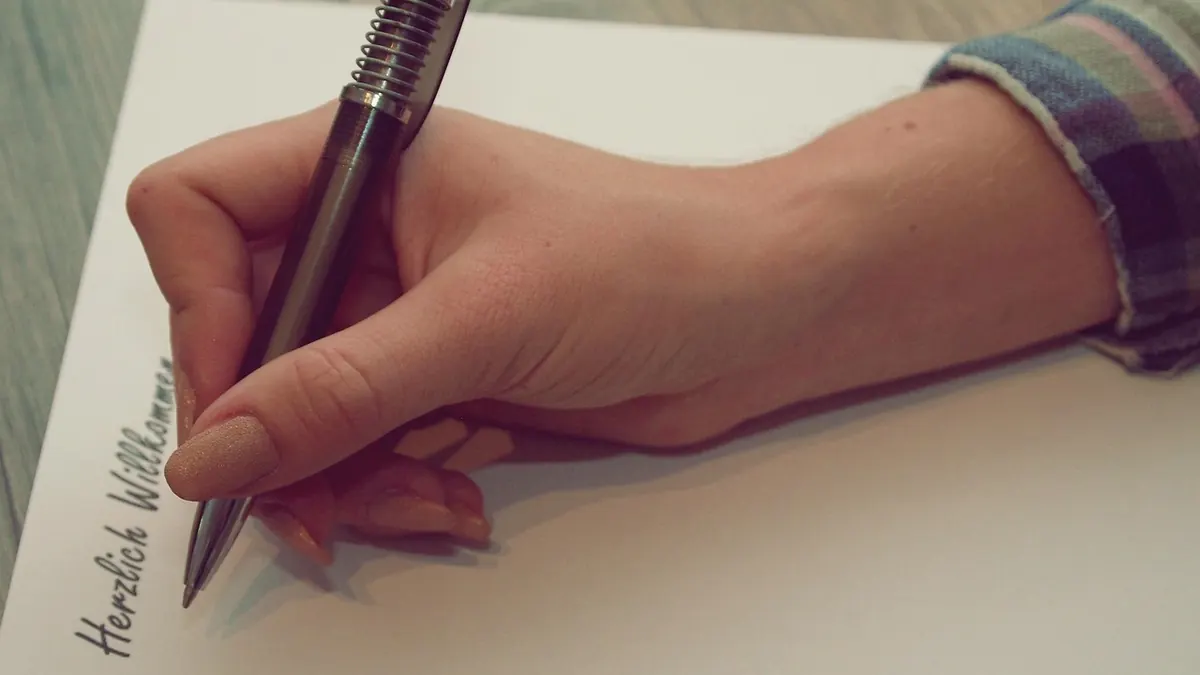
Photo: German Suarez / Pexels